Showing posts with label field trip. Show all posts
Showing posts with label field trip. Show all posts
Tuesday, July 31, 2018
August 2018 Newsletter now available
Check out the August 2018 Beacon for current info about club events, field trips and volunteer opportunities. Also includes info about the upcoming Gem and Mineral show!


Tuesday, May 2, 2017


Tuesday, April 11, 2017
Great advice about Rockhounding safety
Here is a great article that will help you make sure you are safe when out in the field. Be sure to check it out!
Monday, December 5, 2016
November Field Trip Report
by Club Member Anita Williams
We met as usual in the Visitor Center parking lot on a beautiful fall morning.
Promptly at 8:30 am the vehicle caravan departed heading south towards Lordsburg.
We regrouped at the Pilot station on I-10 fueling up with gas
($.30 cheaper than Silver, but that’s no surprise), coffee and/or
breakfast.
There was some "de-fueling" too although we were told there is a rest stop right in Hachita that could accommodate folks in need.
We were heading for the abandoned Apache Mine in the Apache Hills south of Hachita.
We accessed the mine area after a four mile drive on a dirt road.
The area had numerous tailing piles and some trenches and a few debris filled shafts.
Of course the group gathered their buckets and hammers and scattered across the area in search of rock/ minerals samples.
The following data was taken from an article by Wofgang Elston, Mining Districts of Hildago County, NM, in NMGS, 17th Field Conference.
The Apache mine started production in the 1880’s. Between
1880 and 1929 the mine shipped low-grade malachite in calcite to
smelters in El Paso and Douglas to be used as flux in the smelting
process.
From 1929 on there has been some production and sporatic exploration.
The mineral deposit was formed during the Laramide (late
Cretaceous to early Tertiary age: the time of the uplift of the Rocky
Mountains) and was associated with an igneous intrusion in the Apache
Mountains.
The associated fluids formed what is called a contact metasomatic deposit.
This caused the limestone formation to be altered/replaced by mineralizing solutions.
The alteration produced the massive beds of calcite present at
the mine site, and as a consequence, the beautiful calcite rhombhedrons
scattered all over the area.
Other minerals found on site include malachite, azurite, chrysocolla and possibly turquoise.
After collecting at the mine a few vehicles took off to look for quartz crystals farther down the dirt road. This part of the road was a bit more challenging with a 2 wheel drive and it is not recommended.
We drove through several steep washes over several miles until we were stopped at a wash out.
Fortunately there were nice pieces of quartz and some crystal terminations scattered over the entire area.
So although we did not get to the specific location we were able to collect some nice samples.
In this area, the quartz is weathering out of the limestone so it is scattered on the surface over a large area.
We all loaded up and drove out in mass in case someone had trouble making it over some of the rougher road segments.
Happily we all made it to the pavement without incident. There was a photo stop at the Hachita rest area prior to heading back to town with our treasures.
Saturday, October 15, 2016
October Field Trip and Pick Nick

From Andy Anderson: "Here are some pictures of our Pick Nick today at our geode claim. There were 25 of us hunting geodes and as always eating."


Saturday, August 27, 2016
Show Field Trips - Important information!
Grant County Rolling Stone 2016 Gem & Mineral Show
FIELD TRIP SCHEDULE
Saturday September 3RD - 1:00PM – GEODE CLAIM This trip will be to the club’s geode claim off of Bear Mountain Road. The road is fine for all vehicles up to the turn off of the claim. At that point High Clearance vehicles are recommended. There has been new ground worked up and will provide all participants with the opportunity to locate whole or partial agate filled geodes also known as Thunder Eggs. Small shovels or digging tools will be helpful and also a bag or bucket to carry home your treasures. Meet in the hall at the entrance of the gym. If you don’t have a High Clearance Vehicle, see if you can catch a ride with someone who does. This trip will last about 2 hours.
Sunday September 4th – 10:00 am – Silver City Range This trip will be to the Silver City Range just south of Bear Mountain. Access through Forest Service Road 862 will take us along the spine of the range. Rocks we will encounter will include ocean deposits with coral and bivalve fossils, sedimentary sandstone rocks and metamorphosed rocks with collectable scarn minerals. The road is a rough one lane so carpooling with high clearance vehicles is advised. Meet in the hall at the entrance of the gym. This trip will last about 2 ½ hours.
Sunday September 4th – 1:00 pm – 49rs Gold Club
This trip will be to the 49rs Pinos Altos claim where we will teach prospecting a creek for a place to mine. We will show different types of equipment in recreational gold mining and show how to use them weather permitting what types of equipment. All gold found will be distributed among the visiting participants. The trip will last between 2 to 3 hours. The claim is located directly off of the paved road and any vehicle can make it there. Meet in the hall at the entrance of the gym.
The Silver City 49rs will have an area for gold panning demonstrations and information about their club at the show. They will be available each day of the show from 10am to 4pm. They will also have some different types of equipment on display.
Monday September 5th – 11:00am – Amethyst
This trip will be up Boston Hill to collect local Amethyst. This will require a 6 tenths of a mile hike up a somewhat steep and rocky trail. There will be several rest stops on the way for those who need it. To get to the colorful crystals some digging will be required. A small shovel, rock hammer and chisel will also be helpful. There are a lot of clear crystals on the surface to collect for those who do not wish to dig.
PLEASE REMEMBER SAFETY FIRST AND GOOD ROCKHOUND ETIQUETTE. BRING LOTS OF WATER AND IF YOU PACK IT IN PACK IT OUT!
Sunday, July 24, 2016
July Field Trip
Submitted by Jeannine Weiner
We went on a trip to Kingston to hunt crystal Scepters. As a side
attraction we stopped at the North Percha Saloon. This is located on a
forest road between Kingston & Hillsboro about 7 miles north of Hwy
152.

Thursday, June 30, 2016
June Field Trip Report
Hot! Hot! Hot! Sound like a mid-June field trip in SW New Mexico? Yes is the correct answer in case you had any doubts. First I have to add a comment on last month's trip to the Grandview Mine. I did find a reference to gold production at the mine after I sent in the report. So I just wanted to set the record straight that some gold was produced from the Grandview in its later years of production.
The June field trip started out with the usual sign-in at the Visitor Center. A good number of participants turned out for the trip. We all drove out Hwy 180 to the Gila turnoff, drove thru Gila and continued on to the Turkey Creek road. This area is the Gila Fluorspar mining district which consisted of three mines, the Foster, Clum and Victoria. The mines produced from the early 1880's (Foster) through the late 1940's. The ore was used primarily as a flux in smelting of metal ores. At first it was shipped to Silver City and then during the war efforts it was shipped via truck and rail to processing plants in Deming and Lordsburg until 1943. The government contracted a mill to be built in Gila at that time. Most of the ore was then sent to a steel mill in Pueblo, CO. The Clum mine had a brief resurrection in the 1970's with its ore being used to produce hydrofluoric acid. All the mines are currently abandoned.
Fluorite or fluorspar is calcium fluoride, CaF2. It crystalizes in isometric forms commonly occurring as cubes and octahedrons. It also breaks along very distinct cleavage planes. Colors are commonly clear, purple, blue, green with yellow and pink from some locations. It is used as a flux in smelting metals; in the manufacture of hydrofloric acid; in the manufacture of glass and enamel; and in jewelry.
The fluorite veins in the Gila district were deposited along faults and fractures through volcanic latites from the Mogollon volcanic period. The faulting and mineralization occurred during the development of the Barsin Caldera between 28 to 17 million years ago.
Our first mine stop, the Foster, was not far from the road. We all hiked in and started scouring the tailings finding lots of pieces of fluorite glittering in the sunlight. Most were clear, but some were a faint green/blue. Down the hill a little was there was a cut through the rock which lead to a blocked off adit. HIgh angle veins of fluorite cut thru the bedrock, latite, here and with some arm-strong hammering and prying some nice samples of green and purple banded fluorite were collected. There was plenty to share with the rest of the group. A few samples with nice cubic crystals were also found in the area.
Everyone toted their treasures back to the vehicles and we were off to the next location. The road was not bad for a dirt road but a bit of a challenge in places for a sedan-type vehicle. The second stop was touted as a drive-right-to-the-mine site, but most of us opted to park up top and hike down to the the site which wasn't too far. Again the tailing piles were aglitter with fluorite pieces. Some folks had great spots that they excavated with great abandon plucking up nice fluorite samples. Others choose to work on breaking down some boulders with fluorite veins running thru them. Again some nice samples of green with some purple were collected. In this area there were some nice, albeit small, samples with octahedral crystal clusters. Most of these were purple with some clear. All had a great time hammering boulders into small rocks in the quest for a beautiful sample.
We then continued on the road stopping at one point for Ansel to out another fluorite mine. It was an uphill hike and we were all hot and uninterested in exploring the location. We continued up, over and down, down, down the road into the Gila River valley. The scenery was stunning coming down into the valley. At the intersection of the dry creek bed we stopped and hiked to a hot springs. Something about a hot springs in 100° weather that wasn't too appealing. We all tested the water temperature water and decided to find the Gila River for lunch and a wade in the cool water. It was a fine end to yet another fun field trip.
Tuesday, May 31, 2016
May Field Trip Report to Grandview Mine
May Field Trip Report
Our field trip for May was a collecting trip to the Grandview Mine up in the Mimbres/Black Range Mountains. We headed east on 180 from our gathering point at Walmart, turned onto 152 at Bayard and to continued east the Hwy 61 junction where we turned south for several miles. South of San Juan we turned onto Royal John Mine road crossed the Mimbres and started gaining altitude. We remained on Royal John Mine until we entered the National Forest where we turned left onto Silver Gulch road. Silver Gulch was a slow-go, mostly one lane, bumpy, dirt road. It took us farther up the mountains and through some beautiful back country and into the pines. After about a 2 hour drive we reached an old, log prospectors cabin and stopped to look around. There was another cabin a bit farther down the road in better condition that we also visited. Finally we reached the end of the road and the Grandview mine dumps.
The Grandview, appropriately named by the way, was actually discovered in the early 1900's, but had no recorded production until 1933. Although it has been called a gold mine, the only production records I could find listed the ores as lead, zinc and copper. The primary ore minerals were sphalerite, chalcopyrite, helvite and galena. The gangue minerals included calcite, fluorite, garnet, epidote, pyrite, and quartz.
The actual mine was an underground adit with about 1000' of drift. The ore was hosted in a late Ordovician limestone cut by the north striking Grandview fault. The mineralizing fluids replaced the limestone along the fractured fault zone and created the ore body. From the production 1933 to 1951 production records, the ore was 3.71% lead, 9.4% zinc, and .22% copper.
Our trip was focused on collecting some of the nice pyrite crystals located all around the tailing piles. So everyone spread out along the road and/or down the hill with buckets and hammers in hand in quest of the shiny mineral. Pyrite is iron disulfate, also called fool's gold, and is a very common mineral. It is brassy yellow and commonly forms cubes often with striations on one side. It is also brittle and breaks unevenly. It didn't take long for the collecting to begin. The tailing piles were glittering with pyrite sparkling in the sunshine. The largest pieces I saw were maybe an inch on a side, but the nicest crystals were smaller and could be found loose on the tailings or as clusters in the waste rock. Other minerals found included clear fluorite, sphalerite and some epidote.
By afternoon folks began the trek down the bumpy road down the mountain with buckets full of mineral treasures. It was another beautiful day in the mountains and a fun rockhounding trip.
Our field trip for May was a collecting trip to the Grandview Mine up in the Mimbres/Black Range Mountains. We headed east on 180 from our gathering point at Walmart, turned onto 152 at Bayard and to continued east the Hwy 61 junction where we turned south for several miles. South of San Juan we turned onto Royal John Mine road crossed the Mimbres and started gaining altitude. We remained on Royal John Mine until we entered the National Forest where we turned left onto Silver Gulch road. Silver Gulch was a slow-go, mostly one lane, bumpy, dirt road. It took us farther up the mountains and through some beautiful back country and into the pines. After about a 2 hour drive we reached an old, log prospectors cabin and stopped to look around. There was another cabin a bit farther down the road in better condition that we also visited. Finally we reached the end of the road and the Grandview mine dumps.
The Grandview, appropriately named by the way, was actually discovered in the early 1900's, but had no recorded production until 1933. Although it has been called a gold mine, the only production records I could find listed the ores as lead, zinc and copper. The primary ore minerals were sphalerite, chalcopyrite, helvite and galena. The gangue minerals included calcite, fluorite, garnet, epidote, pyrite, and quartz.
The actual mine was an underground adit with about 1000' of drift. The ore was hosted in a late Ordovician limestone cut by the north striking Grandview fault. The mineralizing fluids replaced the limestone along the fractured fault zone and created the ore body. From the production 1933 to 1951 production records, the ore was 3.71% lead, 9.4% zinc, and .22% copper.
Our trip was focused on collecting some of the nice pyrite crystals located all around the tailing piles. So everyone spread out along the road and/or down the hill with buckets and hammers in hand in quest of the shiny mineral. Pyrite is iron disulfate, also called fool's gold, and is a very common mineral. It is brassy yellow and commonly forms cubes often with striations on one side. It is also brittle and breaks unevenly. It didn't take long for the collecting to begin. The tailing piles were glittering with pyrite sparkling in the sunshine. The largest pieces I saw were maybe an inch on a side, but the nicest crystals were smaller and could be found loose on the tailings or as clusters in the waste rock. Other minerals found included clear fluorite, sphalerite and some epidote.
By afternoon folks began the trek down the bumpy road down the mountain with buckets full of mineral treasures. It was another beautiful day in the mountains and a fun rockhounding trip.
Tuesday, March 8, 2016
February Field trip to the Bootheel
Submitted by Club VP - Anita Williams
(Click to enlarge images)

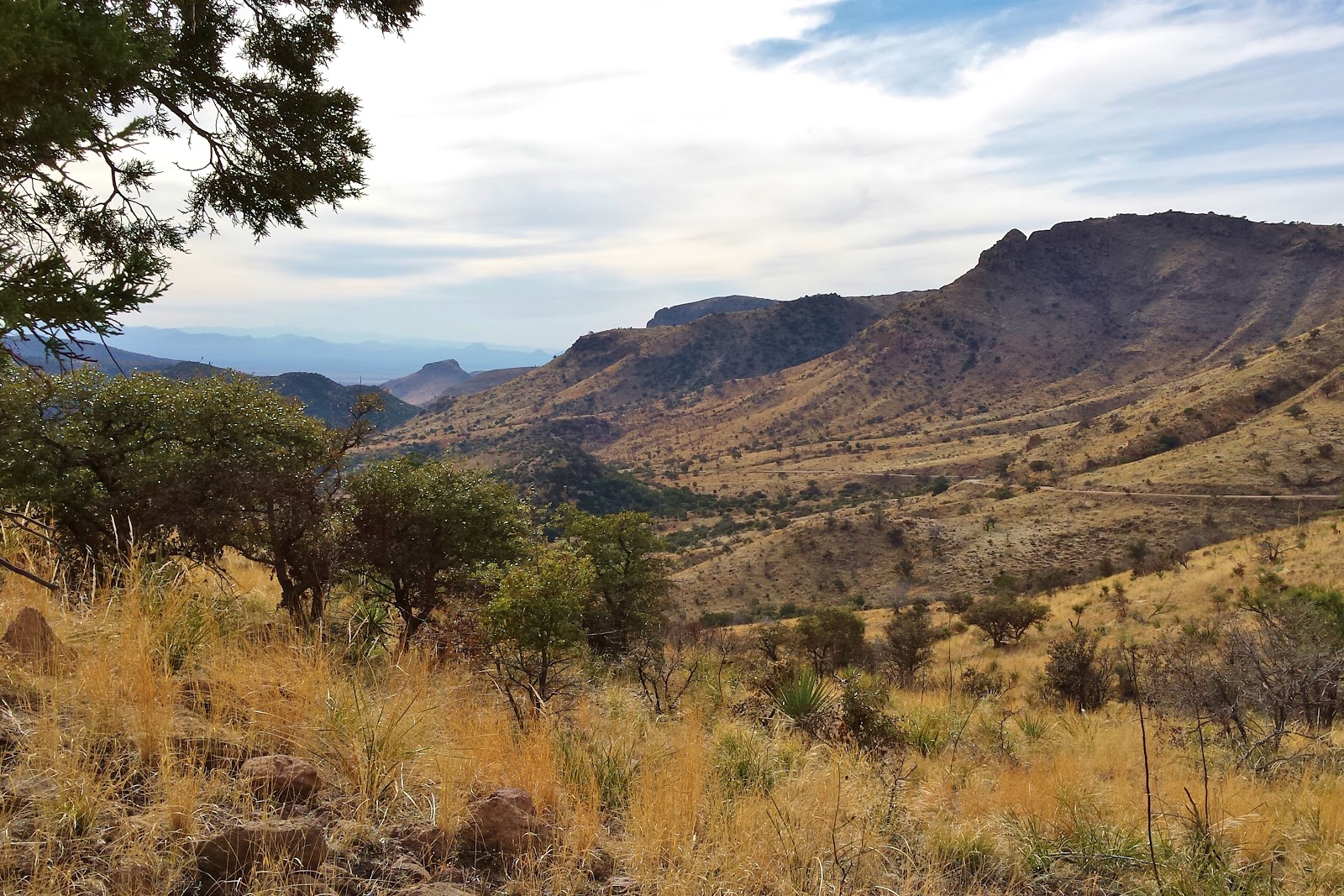
The Club February field trip met up at the Visitor Center and then headed out down to Lordsburg. From there we headed due south and drove thru the Animas Valley down to the boot heel and the Coronado National Forest.


The collecting locations are in the Guadalupe Mountains which are composed of Tertiary aged volcanoclastics and sediments within the Geronimo Trail Caldera. The volcanics are very silica rich and produced abundant rhyolites, chalcedony and quartz.
The first stop was in Clanton Canyon just inside the Forest boundary. We parked and walked south scouting the hill and the stream bed. This whole area was the scene of active volcanic and hot spring activity. We found some great metamorphic rocks some with small garnets, lots of chalcedony and some great yard rocks.
 The next stop was further up the canyon and up a side road to a place called Black Dam. This area is host to more chalcedony and chalcedony filled geodes. The area east of the parking area and down a gully produced a lot of nice geodes which were already opened. Lots of material may produce geodes, but they have to be cut. I did not take the time to explore much more of the site, but there is likely a very large area where the geodes, some of them quite nice, can be found.


(Click to enlarge images)

The Club February field trip met up at the Visitor Center and then headed out down to Lordsburg. From there we headed due south and drove thru the Animas Valley down to the boot heel and the Coronado National Forest.


The collecting locations are in the Guadalupe Mountains which are composed of Tertiary aged volcanoclastics and sediments within the Geronimo Trail Caldera. The volcanics are very silica rich and produced abundant rhyolites, chalcedony and quartz.
The first stop was in Clanton Canyon just inside the Forest boundary. We parked and walked south scouting the hill and the stream bed. This whole area was the scene of active volcanic and hot spring activity. We found some great metamorphic rocks some with small garnets, lots of chalcedony and some great yard rocks.


Friday, January 22, 2016
Ash Canyon January 2016 Field Trip
Contributed by Anita Williams
 The monthly field trip for January was to Red Rock, NM. We had a beautiful day and a nice turnout, including many new members. Ansel took us through the Burro Mts to get to our destination. The dirt roads were in good shape with a little snow and ice on the shady sections of the road. We popped right out on the road to Red Rock and proceeded to go through “town” and over to Ash Creek. The countryside was actually lush, on southwest New Mexico standards, thanks to all the snow and rainfall we’ve had.
 Our target was finding ricolite in the drainage downstream from the actual outcrop of the rock. We all parked at the gate and then spread out across the small valley. This area has been picked over by rock hounds for years, but we were still able to find some small specimens showing very nice color and banding. At the very least there were beautiful colors of rocks and pebbles which were collected for tumbling, cutting and rock garden display. One piece of fossil wood was found that probably washed out from the overburden above the creek bank.
 Ricolite is variety of serpentine also known as “verd-antique.” It is green and banded with a variety of colors including yellow, blue, black, and white. The rock polishes beautifully. In fact it was mined in the late 1800’s and fashioned into items such as ash trays and lamp bases. It was also used as decorative stone is some buildings in Chicago. Mrs. L.J. Cadwell of Chicago is credited with giving the name ricolite to the stone (Mineral Resources,1892, p.411). This information was taken from Minerals of New Mexico, revised ed. 1959, by Stuart Northrop.
 We gathered back at the vehicles for lunch and since it was still early in the day decided to go to another nearby location to collect psilomelane It was an abandoned manganese mine called the Commadore. We followed Dan to the location, parked the cars and did an easy hike to an area which had been trenched.
 The psilomelane was easy to spot since it was black and was “intruded” into the bedded conglomerates throughout the area. There were pieces of the ore lying on the surface, but some of the prettier samples were the psilomelane intruding the conglomerates and producing a breccia of black rock with colorful fragments of rock floating in it. There were some chalcedony roses found in the area too. It was a fun spot to collect and explore.
We all collected our buckets and bags and headed back to the parking area. Smiles all around. It was a good day rockhounding.


 The monthly field trip for January was to Red Rock, NM. We had a beautiful day and a nice turnout, including many new members. Ansel took us through the Burro Mts to get to our destination. The dirt roads were in good shape with a little snow and ice on the shady sections of the road. We popped right out on the road to Red Rock and proceeded to go through “town” and over to Ash Creek. The countryside was actually lush, on southwest New Mexico standards, thanks to all the snow and rainfall we’ve had.
  Our target was finding ricolite in the drainage downstream from the actual outcrop of the rock. We all parked at the gate and then spread out across the small valley. This area has been picked over by rock hounds for years, but we were still able to find some small specimens showing very nice color and banding. At the very least there were beautiful colors of rocks and pebbles which were collected for tumbling, cutting and rock garden display. One piece of fossil wood was found that probably washed out from the overburden above the creek bank.
 Ricolite is variety of serpentine also known as “verd-antique.” It is green and banded with a variety of colors including yellow, blue, black, and white. The rock polishes beautifully. In fact it was mined in the late 1800’s and fashioned into items such as ash trays and lamp bases. It was also used as decorative stone is some buildings in Chicago. Mrs. L.J. Cadwell of Chicago is credited with giving the name ricolite to the stone (Mineral Resources,1892, p.411). This information was taken from Minerals of New Mexico, revised ed. 1959, by Stuart Northrop.
 We gathered back at the vehicles for lunch and since it was still early in the day decided to go to another nearby location to collect psilomelane It was an abandoned manganese mine called the Commadore. We followed Dan to the location, parked the cars and did an easy hike to an area which had been trenched.
 The psilomelane was easy to spot since it was black and was “intruded” into the bedded conglomerates throughout the area. There were pieces of the ore lying on the surface, but some of the prettier samples were the psilomelane intruding the conglomerates and producing a breccia of black rock with colorful fragments of rock floating in it. There were some chalcedony roses found in the area too. It was a fun spot to collect and explore.
We all collected our buckets and bags and headed back to the parking area. Smiles all around. It was a good day rockhounding.


Wednesday, December 16, 2015
Field trip to Zuhl
 The Rolling Stones November Field trip was a rather civilized affair. Ansel arranged a Saturday tour of the Zuhl Museum on the NMSU campus in Las Cruces. The Zuhl’s became fascinated with fossil wood after a visit to northern Arizona and the Petrified Forest area. They followed their passion by collecting polished and massive samples of petrified wood from all over the US. Soon their interests grew to include fossils and mineral specimens. Of course collections of this magnitude soon outgrow the house or even the warehouse. The Zuhls relocated to Las Cruces from the east coast and donated the collection to NMSU for public display.
  We all gathered in the entry room and met our guide for the tour who introduced us to the history of the Zuhls and the collection. It was a little hard to pay attention since the walls were covered with beautiful polished slabs of petrified wood mounted on the walls. It was distracting to say the least. The guide then took us into the second room with displays of more petrified wood and a very impressive collection of fossils. The guide then took us through a tour of geologic time ranging from Precambrian stromatolites, to Cambrian trilobites, to mid-Paleozoic crinoids, and on to Cenozoic reptiles and insects. One of the favorite samples was the fossilized nest of oviraptor eggs. Or maybe it was the perfect fossilized remains of the dragon fly in limestone from Germany. It was hard to pick a favorite with so many spectacular specimens from which to choose. The museum is well worth a visit. Check out the website for more information at www.zuhlmuseum.nmsu.edu
Thursday, November 5, 2015
Info for November Field Trip
Field trip coordinator Ansel Walters suggest that members review this great handout for the Prehistoric Pathways National Monument before the November field trip.
Wednesday, July 29, 2015
July club field trip
 |
Samples of coral, limestone showing mineral alteration and a volcanic rock with alteration halo and calcite crystals |
The Rolling Stones July field trip was relatively close to home and we had a very nice crowd participating including some young pebble pups. It was nice to have kids along on the trip having fun collecting rocks. As one of our sage members observed during the trip the kids have a distinct advantage in rock collecting since they are closer to the ground. There is definitely something to that along with keen eyes and abundant enthusiasm.
 |
| Field Trip Participants |
Saturday hosted a clear blue New Mexico sky as we all gathered at Walmart at 8 am. Right on schedule the car-a-van lined up and headed east for the Georgetown area. Our collecting locales were in the Devonian/Mississippian limestones.
It was a short ride over to our first stop just off the Georgetown Road. We searched the area for limestone garden rocks. In this spot there were some outcrops of lovely, weathered limestone blocks, but many were too big to handle on this trip. Next stop was similar except the hillside also hosted some beautiful cacti some of which George collected for his cacti garden. The limestones in this area were fossiliferous too.
 |
| Samples from the Prospect pit--the top rock is gossan on limestone, dendrites on clay and examples of bands of alteration |
 |
| Silicified corals |
Our last official stop was near the old Georgetown townsite. Down in the stream valley folks were finding some brachiopods and crinoids. I was farther up the hill and found lots of old glass and square nails. Ansel went off to check on another collecting area, but the day was hot and everyone was tiring. Everyone opted out and headed back to town to look over their new found treasures.
 |
| Field Trip Participants |
Tuesday, June 30, 2015
June Club Field Trip to Luna NM
It was a warm, clear, sunny day on Saturday as folks gathered to sign in for the field trip to Luna. The day was quite a contrast to last month when we met for the trip on a gray, rainy morning and found Ansel there telling everyone to come back next month. He said the roads we had to traverse to get to the collecting area were dirt and access would be difficult in the rain. Not only that but the storm apparently dropped snow in Luna.
One month later we are back to the meeting spot at Long John Silvers. This time the weather is perfect for the trip and after signing up we all took off heading north on Highway 180. Our first stop was a side trip down Mineral Creek Road in Alma. A few miles up the road we stopped to visit the gravesite for a prospector

After a group photo, we were back on the road again. Up and over two passes

Linda and I pulled into a nice parking spot and stared scouring the ground for agates. Agates could actually be collected right from the roadbed and ditches. I grabbed a sample bag and a water bottle (it was HOT and we were in a part of the forest that had burned so there was very little shade). Linda opted for a sample bag, water bottle and an umbrella for portable shade. It didn’t take too long to get our eyes adjusted to finding agates.

There were a lot to be had in colors from light gray and white to dark purple. The dark purple were more scarce than white and gray colors so it was exciting when one was found. As I worked my way from the dry stream bed up the hill there was a zone with a few blue/purple agates, and quite a few with quartz crystal-lined voids. Quite a variety of rocks in a relatively small area. We took a break for lunch and some time under the shade of our golf umbrellas. After a lunch we made one last look-around to see if we could find something different from what we’d already found.
Time went by quickly and folks started packing up for the 3 hour trip back to Silver City. We were enjoying the hunt but decided that we had better get packed up too. As we departed we made a quick stop at the top of the hill and Linda found a small plate of rock covered with quartz crystals. Wow, that means there will be plenty more areas to rock hound on the next field trip to Luna.
We made a stop for gas in Glenwood since it was cheaper than gas in Silver City (hum, I haven’t figured that situation out yet…). It seemed HOT, but we did not have a thermometer so I asked the fellow at the station. He said it was 103°. It was just too darn hot to pass up the opportunity to stop for ice cream (strawberry being the only flavor for the day) at the local rock shop. Ahhhhh refreshing and we got to look at some New Mexico rock specimens including Luna agate and quartz clusters. Nice way to top off the trip.

Sunday, April 19, 2015
Harden Cienega Field Trip
Submitted by Club Member Andy Anderson


 Here are some photos of our trip. First we stopped at the Viking long house being
built at Mule Creek Adobe which was really nice. Then we went to the adobe factory and found how
adobe is made and saw a 75 year old adobe maker machine. Next we went to a wash where they got their sand
for the adobe. It was loaded with obsidian nodules. The group gathered up some
obsidian.
Here are some photos of our trip. First we stopped at the Viking long house being
built at Mule Creek Adobe which was really nice. Then we went to the adobe factory and found how
adobe is made and saw a 75 year old adobe maker machine. Next we went to a wash where they got their sand
for the adobe. It was loaded with obsidian nodules. The group gathered up some
obsidian.
 On we went to Harden Cienega and the lava flows for
more obsidian. The ground was covered with little nodules just right for
tumbling. Jim and his dog seemed to be having a good time.
On we went to Harden Cienega and the lava flows for
more obsidian. The ground was covered with little nodules just right for
tumbling. Jim and his dog seemed to be having a good time.
 Last we drove to a canyon that was the head waters
of the San Francisco river. The canyon was beautiful. We saw a little horn toad
while looking around there. All in all, it was a great trip.
Last we drove to a canyon that was the head waters
of the San Francisco river. The canyon was beautiful. We saw a little horn toad
while looking around there. All in all, it was a great trip.


Subscribe to:
Posts (Atom)